For OEMs sourcing custom rubber components, choosing between injection molding and compression molding affects more than the manufacturing method. It influences tooling investment, production efficiency, dimensional consistency, material waste, and the final cost per part.
Neither process is universally better. The right choice depends on part geometry, rubber compound, annual demand, tolerance requirements, and the conditions in which the component will operate. For buyers working with a custom rubber parts manufacturer such as Xiamen Fuste Rubber & Plastic Co., Ltd., evaluating these factors early can help reduce tooling changes and production risks.
Quick answer: Compression molding is often suitable for simpler rubber components, lower production volumes, and projects where initial tooling cost matters most. Injection molding is generally more attractive for complex geometries, repeatable high-volume production, and applications that benefit from automated material delivery and shorter molding cycles. Final selection should be validated against the actual part design and production requirements.
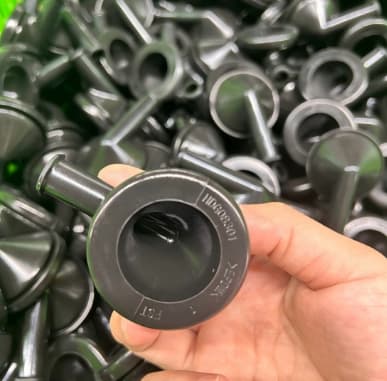
Compression molding begins with a measured quantity of uncured rubber placed directly into a heated mold cavity. The mold closes under pressure, forcing the compound to take the required shape while heat initiates vulcanization. After curing, the part is removed and may undergo trimming or additional inspection.
This relatively straightforward process is commonly considered for rubber pads, gaskets, covers, seals, and other components with practical mold designs. It can be a sensible option for prototype development, lower-volume orders, or parts that do not require the higher production rate of a fully optimized injection molding setup.
For OEM buyers, the main advantage is the potential to keep initial tooling investment manageable. Compression molding can also accommodate a broad range of rubber compounds and part sizes, depending on the mold design and equipment available.
However, buyers should account for manual material loading, curing time, potential flash, and trimming requirements. These factors can influence labor cost, output per shift, and dimensional consistency. A lower initial tooling cost does not automatically mean the lowest total cost over the product's lifetime.
Fuste Rubber provides custom molded rubber parts for automotive and industrial applications, including protective covers, grommets, pads, and sealing components. The appropriate process should be confirmed against the specific drawing, compound, and expected order volume.
In rubber injection molding, the compound is prepared and delivered into a closed mold cavity through an injection system. The mold then maintains the required temperature and pressure while the rubber cures. Once the curing cycle is complete, the finished part is removed for inspection and any necessary finishing operations.
Compared with conventional compression molding, injection molding can improve process automation, reduce some material handling steps, and support repeatable production across large batches. It is particularly worth evaluating when a component has intricate features, multiple cavities are needed, or the OEM expects demand to remain high over an extended production program.
Injection molding still requires careful control of mold design, compound behavior, injection pressure, temperature, and curing conditions. Complex tooling can increase the initial investment, and an unsuitable gate or runner design may create filling or quality issues. The process must be engineered around the actual rubber formulation rather than selected on speed alone.
Fuste Rubber's rubber injection molding equipment page provides additional context on the company's injection molding process and equipment. OEM buyers can use this information as a starting point when discussing production requirements with the supplier.
The following comparison summarizes the typical trade-offs. Actual results vary with part geometry, rubber compound, mold cavity count, equipment configuration, and inspection requirements.
| Evaluation factor | Compression molding | Injection molding |
|---|---|---|
| Initial tooling investment | Often lower for simpler designs | Often higher due to more complex tooling |
| Production efficiency | May involve more manual handling and longer cycles | Can support shorter cycles and greater automation |
| Part geometry | Well suited to many simple or moderately complex parts | Often advantageous for complex or repeatable molded features |
| Dimensional consistency | Depends on charge preparation, tooling, and operator control | Can offer strong repeatability with a validated process |
| Material waste | Excess material and trimming may be required | Can reduce some waste, depending on runner and mold design |
| Typical project fit | Prototypes, simpler parts, and low-to-medium demand | Complex parts and stable, higher-volume programs |
One important distinction for procurement teams is the difference between tooling cost and total cost of ownership. A compression mold may be less expensive to build, but higher labor requirements or longer cycle times can increase the cost per component. An injection mold may require a larger initial commitment but become more economical as production volume increases.
There is no universal order-volume threshold at which injection molding becomes the better option. The break-even point depends on the mold quotation, cycle time, cavities, material usage, scrap rate, finishing operations, and forecast demand. Requesting a cost comparison for the same component under both processes is more reliable than relying on a general industry rule.
OEMs should begin with the functional requirements of the part, then compare manufacturing economics. A supplier should be able to explain why a process fits the design rather than recommending a method based solely on available machinery.
For example, a molded rubber pad used in a general industrial assembly may be a good candidate for compression molding if its geometry and tolerances allow it. A high-volume automotive component with detailed features and strict assembly requirements may justify injection molding after tooling and process validation.
Consider a custom automotive rubber wiring gaiter. Its corrugated structure must flex during vehicle door movement while protecting the wiring from water, dust, and abrasion. The manufacturing recommendation should therefore consider the geometry, required flexibility, sealing performance, tooling design, and expected annual volume together.
Choosing between injection and compression molding does not replace the need to select the right elastomer. The rubber compound influences curing behavior, mold filling, flexibility, sealing performance, resistance to environmental exposure, and long-term service life.
Common material considerations include:
These are general selection guidelines, not substitutes for material qualification. Buyers should specify operating temperature, chemical contact, pressure, compression set, hardness, tensile properties, and any applicable regulatory requirements. The exact formulation should be tested against the component's real service environment.
For sealing applications, OEM buyers can also review Fuste Rubber's rubber gasket and sealing product range when identifying suitable components for their projects.
A useful supplier discussion should cover more than the unit price. Before approving tooling, ask for clear answers to the following questions:
These questions are especially relevant for automotive OEMs and Tier suppliers, where a low quoted price has limited value if the component cannot consistently meet drawing specifications. A sound sourcing decision balances manufacturing capability, process validation, quality documentation, and long-term supply stability.
Xiamen Fuste Rubber & Plastic Co., Ltd. manufactures molded rubber components and extruded rubber tubes for automotive and industrial applications. Its published company information describes capabilities covering elastomer materials, mold design and fabrication, and production, with applications including automotive electrical systems, engines, chassis, cooling systems, and fuel systems.
For OEM buyers, this manufacturing scope provides a starting point for discussing custom rubber parts based on drawings or samples. The key is to confirm the specific process, material grade, dimensional requirements, testing plan, and order volume for each project before finalizing a quotation.
To evaluate a project, prepare the part drawing or sample, annual demand forecast, material requirements, critical tolerances, operating conditions, and target delivery schedule. Fuste Rubber's team can then assess the requirements and discuss an appropriate manufacturing route.
Visit the Fuste Rubber website to explore the company's product range, or contact the team about your custom rubber part requirements.
Not in every case. Injection molding often suits complex parts and higher-volume production, while compression molding can be more economical for simpler components and projects with lower initial tooling budgets. The best process depends on the design, compound, production volume, and quality requirements.
Compression molding often has lower initial tooling costs for simple parts. Injection molding generally requires more complex tooling, although the additional investment may be offset by improved production efficiency at sufficient volume.
Injection molding is often a strong candidate for stable, high-volume programs because it can support automation and repeatable cycles. However, the break-even point must be calculated using actual tooling, cycle-time, material, finishing, and quality costs.
Yes. Custom rubber parts can generally be developed from engineering drawings, CAD files, or physical samples, subject to design review and manufacturing feasibility. OEM buyers should provide dimensions, material requirements, hardness, tolerances, and operating conditions.
Compare tooling amortization, material consumption, cycle time, labor, scrap, trimming, inspection, maintenance, and expected annual demand. Requesting quotations for both processes using the same part specification provides a more meaningful comparison than evaluating unit price alone.




 online service


