Ozone cracking, compression set, chemical incompatibility, UV degradation, and mechanical fatigue account for most automotive rubber failure analysis cases. These five failure modes leave distinct evidence. Most premature failures trace back to a mismatch between design intent and real-world operating conditions, not random bad luck. Prevention is a manufacturer-side discipline. The stakes are high: costly downtime, safety issues, and reputational damage from unexpected elastomer breakdowns. Engineers who recognize the pattern solve the problem faster. This article examines each mode through its symptoms, root causes, and prevention strategies. It then covers manufacturing challenges, a prevention framework, and the real cost of cheap rubber parts.
Automotive rubber failure analysis traces most rubber part failures to one source: a mismatch between design intent and real-world conditions. Engineers specify a material for nominal temperature, load, and chemical exposure. The vehicle then delivers elevated heat, UV, ozone, repeated motion, and fluids the specification never anticipated. A rubber part failure rarely comes from random bad luck. The assumption behind the part was wrong.
|
Mismatch Category |
Design Assumption |
Real-World Condition |
Resulting Problem |
|---|---|---|---|
|
Environmental exposure |
Rated for nominal temperature/UV/ozone |
Elevated heat, UV, ozone over lifecycle |
Compression set, cracking, loss of sealing force |
|
Mechanical load |
Compression/tension/impact within limits |
Long-term load, over-compression, impact |
Permanent deformation, flattened cross-sections, leaks |
|
Motion |
Treated as static contact |
Repeated sliding, rolling, friction |
Abrasion, material loss, reduced performance |
|
Chemical exposure |
Compatible with expected fluids |
Oils, solvents, cleaners in service |
Swelling, degradation, rapid performance loss |
|
Durometer |
Hardness chosen by assumption |
Actual load and sealing demand differs |
Too stiff to seal or too soft to hold shape |
Consequences compound: leaks, equipment damage, safety issues, downtime, and reputational damage. Two field cases show the pattern. An off-road suspension bushing failed within six months because natural rubber met a minor engine-bay oil leak; the rubber swelled and lost pre-load, producing steering play. An oil-resistant EPDM/PU combination eliminated the problem. Separately, an 85 Shore A stabilizer bar bushing chosen for longer life gave almost no damping and caused fatigue cracking in frame mounts within 30,000 km; a 70 Shore A multi-layer design restored normal life.
Five failure modes dominate the field, and each leaves recognizable evidence.
|
Mode |
Typical Symptom |
Root Cause |
|---|---|---|
|
Material mismatch |
Hardening or cracking; swelling or softening within weeks |
Elastomer incompatible with service temperature or media |
|
Wrong hardness or compression |
Leaks soon after installation; seals hard to install |
Shore A hardness not matched to groove design |
|
Thermal aging |
Surface cracks, loss of elasticity over time |
Continuous service above the material's temperature limit |
|
Extrusion and nibbling |
Ragged, chewed edges under high pressure |
Pressure forces seal into the clearance gap faster than it recovers |
|
Chemical attack |
Seal grows, softens, or disintegrates |
Media compatibility overlooked during specification |
These top root causes share a theme: elastomer physics versus real-world stress. Material selection and groove design decide whether a seal failure occurs. Dedicated sections below examine each mode through symptoms, causes, and prevention.
Ozone cracking leaves a clear signature. Cracks run at right angles to the strain axis, so a bent rubber tube shows cracks around its circumference. They start at exposed surfaces and grow inward until they penetrate the wall of seals or tubes. Crack density rises with ozone concentration, and sharp corners act as initiation sites because stress concentrates there.
The chemistry explains the damage. Ozone attacks double bonds in susceptible elastomers such as natural rubber, SBR, and nitrile rubber. This ozonolysis cleaves the polymer chain, and molecular weight drops sharply until the material loses strength. Ozone sources include electric discharge, corona discharge, static electricity in compressors, and photochemical smog. Freshly exposed crack surfaces then face further attack, so the crack grows steadily until the part fails.
|
Aspect |
Detail |
|---|---|
|
Crack orientation |
Right angles to the strain axis |
|
Crack growth |
Surface inward, penetrating the wall |
|
Vulnerable elastomers |
NR, SBR, NBR, polybutadiene |
|
Common ozone sources |
Electric discharge, smog, static electricity |
Manufacturers build ozone resistance into the compound from the start. Polymer blending is one route: NBR-PVC polyblends with 20–60 phr high-MW PVC resist over 1000 hours of ozone exposure at 40°C and 50 pphm without cracking. NBR-EPDM blends with compatibilizers reach over 800 hours under the same conditions.
Additives form the second line of defense. Antiozonants such as p-phenylenediamine derivatives at 0.5–5 phr act as sacrificial scavengers, though their effect depletes over 6–18 months. Paraffin wax at 0.3–10 phr blooms to the surface and forms a physical barrier. Peroxide vulcanization creates C–C bonds that resist ozone better than sulfur crosslinks. Proper mixing ensures full dispersion, and ozone cabinet testing confirms performance before release. Any unsaturated rubber remains vulnerable, so sealing reliability depends on designing prevention in holistically rather than trusting a single additive.
Compression set is a permanent loss of rebound after time in service. Heat, time, chemistry, and over-squeeze drive the change. A seal with high compression set can look fine. It will not push back and hold its shape, so leaks appear later.
|
Category |
Details |
|---|---|
|
Symptoms |
Flattened or misshapen cross-section; no spring-back; leaks and seal failure |
|
Root causes |
Long compression time; high heat; chemical exposure; soft or low-resilience material; over-compression; aging |
|
Temperature effect |
Heat speeds loss of elasticity; extreme cold causes shrinkage and brittleness |
|
Time effect |
Long-term load exceeds the elastic limit and causes permanent deformation |
Cold shrinkage can open leak paths that remain after the seal warms up. Heat hardens the rubber and changes the gland. Both effects raise the risk of failure.
Cure system choice matters. Conventional sulfur cure creates polysulfidic crosslinks that rearrange under load. Peroxide cure gives stable carbon-carbon crosslinks. Crosslink density needs balance: too little allows viscous flow, too much blocks elastic recovery. Stabilizers protect against oxidative and thermal aging. Compatible plasticizers keep flexibility without raising compression set. Polymer blending, such as NBR with PVC or EPDM, can improve recovery when the blend ratio is right.
Material grade sets the ceiling. Premium specialty compounds can achieve compression set below 20% after 70 h at 125°C through controlled molecular weight and optimized peroxide cure, while high-performance grades maintain low set values below 25% after 70 h at 125°C with continuous heat resistance up to 150°C. FKM and silicone grades hold low compression set above 200°C. Hardness from 40 to 90 Shore A covers most sealing duties. Low-compression-set compounds, correct groove design, and controlled squeeze together preserve sealing force across the service life.
Chemical incompatibility shows up as swelling, softening, hardening, or cracking. A gasket may grow noticeably in service and lose its grip on the mating surface. Absorbed fluid leaches out additives and weakens the material further. These changes produce seal leaks that appear weeks after installation, not at the moment of assembly.
The mechanism is a solubility mismatch. A service fluid chemically similar to the elastomer, close in polarity and solubility parameter, absorbs into the network and forces polymer chains apart. Non-polar elastomers swell in non-polar fluids, and polar elastomers resist them. Process factors such as under-cure or poor dispersion increase uptake, but they only modulate the magnitude. They cannot rescue a fundamentally incompatible material choice.
|
Elastomer |
Generally compatible with |
Generally incompatible with |
|---|---|---|
|
EPDM |
Hot water, steam |
Petroleum-based oils and fuels |
|
NBR |
Oils, fuels, greases |
Strong oxidizers, ketones, brake fluids |
|
VMQ (silicone) |
Hot air, water, weather |
Fuels, concentrated solvents |
|
FKM |
Broad range of oils, fuels, high heat |
Some grades weak to amines, ketones, hot water |
Elevated temperature accelerates these reactions. Above 400 °F, conventional FKMs soften and blister in amine service. A refinery amine regenerator showed hardening and cracking after 300 hours; an anti-explosive-decompression FKM grade doubled the maintenance interval. A caustic wash system swelled EPDM gaskets about 20% after 48 hours at 230 °F, and a switch to Aflas® extended service life four times.
Prevention starts with fluid compatibility review at the design stage. Engineers list every medium the part will contact, including cleaners and temporary fluids, then match the elastomer to that list. NBR suits oils but fails in brake fluid. EPDM handles steam but degrades in fuel. FKM covers a broad range, with grade-specific limits.
Validation confirms the choice. Immersion testing in the actual service fluid at service temperature reveals swelling and hardness change before production begins. Suppliers should provide test data, not just a material datasheet. Correct groove design and controlled squeeze preserve sealing force even when slight swell occurs. A material change alone cannot fix a failure rooted in chemical attack; the specification must change with it.
Sunlight breaks down rubber at the surface first. Ultraviolet radiation carries enough energy to split polymer chains, and oxygen joins the reaction to form photo-oxidation. The damage shows as chalking, color fade, fine surface cracks, and a dull, hardened skin. Cracks then spread inward and reduce elasticity. Exterior trim, weatherstrips, and hoses mounted near glass face the heaviest environmental exposure, and interior parts near windows fade and age as well.
The root cause is energy absorption without a defense. Double bonds and other chromophores in the polymer absorb UV light and start free-radical chain reactions. Chain scission softens the material, while crosslinking hardens it, so the surface and the core age at different rates. Heat and oxygen accelerate the process. A part rated for shade can fail in direct sun, and that mismatch between design intent and real conditions drives most UV-related failures.
Manufacturers compound UV defenses into the rubber rather than relying on one additive. Hindered amine light stabilizers, benzotriazoles, and benzophenones absorb or screen UV radiation and block chain scission, crosslinking, discoloration, and mechanical property loss. Primary and secondary antioxidants work alongside them to interrupt free-radical reactions. Carbon black and specialized pigments act as reinforcing fillers and UV screening agents, and particle size, surface area, and dispersion quality all affect performance.
Surface and polymer routes add further protection:
Tailored stabilization pays off in demanding applications. A customized UV stabilizer developed for automotive headlamp lenses extends lens clarity by 50% longer than standard options and now holds 70% of the automotive headlamp UV stabilizer market. That result shows how matching the stabilizer package to the part and its exposure profile protects sealing performance over the service life.
Repeated stress cycles drive mechanical fatigue. A part flexes, compresses, or stretches thousands of times in service. Small cracks form at stress concentrations, then grow until the material tears. Symptoms include surface crazing, chunking at edges, and progressive loss of elasticity. Dynamic seals and engine mounts often show this pattern before a visible failure appears.
Root causes combine cyclic load, poor geometry, and heat buildup. Sharp corners and undercuts concentrate stress. Over-compression raises internal strain with every cycle. Flexing also generates heat, and elevated temperature speeds crack growth. Abrasion & wear from grit, sliding contact, or rough mating surfaces removes material and shortens the crack initiation phase. A part rated for static duty will not survive a dynamic application.
Designers reduce stress concentration first. Generous fillets, smooth transitions, and correct groove dimensions spread the load. Material choice follows: fatigue-resistant compounds with balanced crosslink density resist crack growth. Reinforcement and suitable hardness keep the part stable under repeated deflection. Validation with dynamic testing confirms the design before production.
Production controls protect the design intent. Consistent mixing, controlled cure, and tight dimensional tolerances prevent weak spots. Clean molds avoid surface defects that seed cracks. Proper installation guidance reduces over-compression and misalignment in the field. Together, these measures extend service life and protect sealing performance across the vehicle's life.
Extrusion defects often signal compound rheology problems rather than machine faults. Sharkskin appears as fine, regular surface roughness driven by elastic instability at the die exit. Gross melt fracture produces chaotic surface failure at high shear rates. Die swell variation reflects lot-to-lot elasticity differences and causes dimensional nonconformance. Cure problems rank among the highest-cost issues in rubber parts manufacturing. Scorch shortens t10 and produces flow marks or incomplete mold fill. Under-cure leaves low hardness and modulus. Over-cure or reversion degrades physical properties. Blistering and porosity create structural defects that lead to in-service failure.
Diagnosticians confirm the defect is compound-driven before adjusting the extruder. A frequency sweep comparing G' to baseline reveals a shifted modulus. Cure curves serve as the primary diagnostic: shortened t10 signals scorch, a declining plateau after MH signals reversion, and t90 confirms optimum cure.
Inconsistent rubber compounds and dimensional tolerancing & fit issues create upstream causes of field failures in rubber components. Uneven heat distribution during vulcanization generates thermal gradients and sustained internal stress. Extended flow paths cause variations in density, cure rates, and filler distribution. Inadequate mold design translates directly into part warpage. These rubber parts manufacturing challenges demand tight process control. Dimensional tolerance for large rubber components runs from ±0.5% to ±2.0% of nominal, with surface flatness deviation not exceeding 0.1–0.3 mm per 100 mm. Shore hardness consistency holds within ±5 Shore A units. Tolerance deviations affect sealing performance and interchangeability, so even small dimensional deviations in rubber parts can cause leakage or system failure.
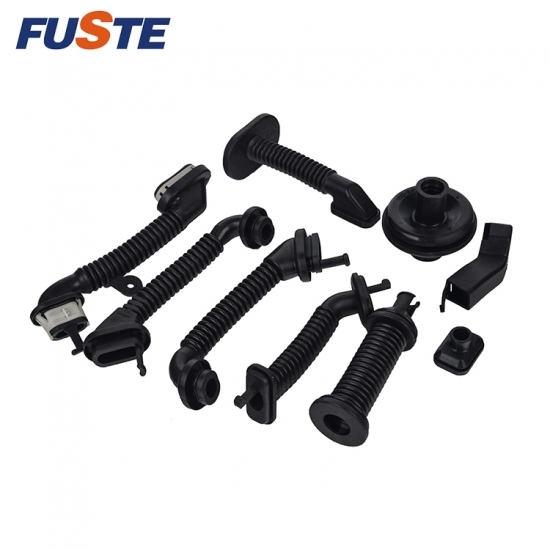
Prevention begins at the drawing board. Engineers trace each failure to pressure, heat, chemical exposure, or installation error. Structured visual inspection links damage patterns such as compression set, extrusion, chemical attack, and thermal degradation to their cause. The design review then examines operating conditions, installation practice, material choice, and dimensional tolerances together. Geometry matters as much as compound. Gland depth and width, clearance gaps under pressure, and mating surface finish all shape service life. Even a correct material fails when dimensional control is inadequate.
The material selection process matches the elastomer to the environment and duty cycle. Media compatibility, temperature extremes, long-term compression performance, and aging characteristics drive the choice. A durometer/hardness mismatch alone can cause leaks or poor damping, so hardness must follow the actual load and sealing demand. The table below summarizes common options.
|
Elastomer |
Temperature Range |
Key Resistance |
Typical Applications |
|---|---|---|---|
|
NR |
-50°C to +70°C long-term |
High tensile and tear strength, resilience; poor oil and ozone resistance |
Vibration mounts, springs, bearings |
|
EPDM |
-40°C to +150°C peroxide cured |
Excellent weathering, ozone, chemical resistance; incompatible with mineral oils and fuels |
Window seals, hoses, O-rings, gaskets |
|
NBR |
-40°C to +120°C |
Good oil and fuel resistance; limited ozone and weather resistance |
Gaskets, seals, hoses |
|
HNBR |
Up to 150°C |
Excellent heat and ozone resistance, best compression set |
Seals needing heat and media resistance |
|
Silicone |
Continuous to 200°C |
Outstanding ozone and weather resistance; low tear strength |
Electrical insulation, static seals |
|
ACM |
150°C typical |
Excellent heat and oil resistance; poor water resistance |
Heat and oil applications |
|
CSM |
Dry heat to 150°C |
Excellent ozone and weather resistance; poor compression set |
Weather-resistant hoses, membranes |
|
ECO |
-40°C to +120°C |
Resistance to heat, oils, ozone; unsuitable for water and steam |
Seals, gaskets, diaphragms |
|
FKM |
-30°C to 200°C |
Outstanding heat, ozone, and chemical resistance |
Shaft seals, O-rings, gaskets |
Validation confirms the choice. Rigorous testing replicates real service conditions: pressure, temperature, and representative media. Engineers measure cross-sections and compression against design intent, then apply acceptance criteria before release. Designing failures out at this stage costs far less than a field recall.
Production controls carry the design into every unit. A TS16949 quality system governs the process, and products comply with ASTM, SAE, DIN, and JIS standards. ROHS, REACH, and FDA certifications cover restricted substances and food-contact duties. Quality control and testing check compound consistency, cure state, and dimensions before shipment.
Fuste illustrates how a manufacturer builds automotive rubber failure analysis into its process. Established in 2004, the company operates a 20,000 square meter factory with annual capacity exceeding 5,000 tons. Its services span formula design, mold making, and final production. That integration supports a prevention framework where material selection, tooling, and process control reinforce one another. Buyers who demand test data and process audits close the loop on rubber part failures.
A low unit price hides the true cost of rubber parts. Cheap compounds often skip the stabilizers, cure controls, and material grades that prevent premature rubber part failures. The part may pass incoming inspection and still fail in the field. Each warranty claim then carries replacement cost, labor, and administrative overhead. Downtime adds more. A vehicle off the road or a line stopped for a failed seal costs far more than the price difference per part. Repeated claims also damage the brand. Buyers remember leaks and breakdowns long after they forget the invoice. Automotive rubber failure analysis usually traces these events back to a sourcing decision, not a random defect. The cheapest part becomes the most expensive one once failure enters the equation.
Procurement teams can screen suppliers with direct questions about material and process. The table below lists the core areas to probe.
|
Evaluation area |
Question for the supplier |
Why it matters |
|---|---|---|
|
Material grade |
Which rubber grade is specified, and can you provide the material datasheet? |
Substitutions can alter durability and noise behavior. |
|
Structure |
Is the part bushing type, ball-joint type, or mixed structure? |
Different structures create different movement and wear risks. |
|
Bonding control |
How is metal-rubber bonding controlled and verified? |
Weak bonding can cause interface failure and early looseness. |
|
Surface treatment |
What cleaning, shot blasting, phosphating, or coating process is used? |
Poor preparation reduces adhesion and corrosion resistance. |
|
Fatigue test data |
What load, angle, frequency, cycle count, and temperature were used? |
A result is only useful when test conditions match the application. |
|
Inspection |
Which dimensions and functions are checked online? |
Inspection gaps allow batch drift. |
|
Traceability |
Can you trace material, process, and inspection data by lot? |
Traceability shortens investigation time when problems occur. |
Suppliers should also confirm manufacturing capability across mixing, metal preparation, adhesive application, vulcanization, trimming, and final inspection. Quality-control discipline matters just as much. Buyers should request cure curve data, hardness reports, surface treatment records, and corrective action reports. Written approval should govern any change to material grade, formulation, tooling, or production location. These checks turn a purchase order into a controlled quality agreement.
Ozone cracking, compression set, chemical incompatibility, UV degradation, and mechanical fatigue each trace back to a preventable root cause. Material mismatch, wrong hardness, and overlooked service conditions drive these failures. Prevention works as a system. Design review, material validation, and process control must reinforce one another. Engineers should specify recognized standards and demand test data. Procurement teams should audit supplier processes and require lot traceability. No single fix replaces this discipline. Automotive rubber failure analysis rewards manufacturers who build it into their quality systems. Fuste, established in 2004, integrates formula design, mold making, and production under one roof. That structure turns prevention into daily practice.
The damage pattern gives the answer. Cracks at right angles to strain point to ozone. A flattened cross-section signals compression set. Swelling or softening indicates chemical attack. Chalking and surface cracks suggest UV exposure. Crazing and chunked edges reveal mechanical fatigue. Each pattern links back to a specific root cause.
No. Antiozonants deplete over time, and wax barriers wear away. Durable protection combines polymer blending, additive packages, and peroxide cure. Unsaturated rubber stays vulnerable regardless. Manufacturers validate the full compound in ozone cabinet testing before release.
Geometry and process often decide the outcome. Sharp corners concentrate stress. Over-compression raises internal strain. Poor cure control leaves weak spots. A correct compound cannot compensate for a flawed groove design or inconsistent production. Design review and process control must reinforce material selection.
Buyers should request material datasheets, immersion and fatigue test data, and cure records. They should confirm compliance with ASTM, SAE, DIN, and JIS standards, plus ROHS, REACH, and FDA certifications where required. Written approval should govern any change to formulation, tooling, or production location.
Yes. A durometer mismatch alone causes leaks or poor damping. Too stiff a part cannot seal; too soft a part cannot hold shape. Manufacturers offer hardness from 20A to 80A shore, and the specification must follow the actual load and sealing demand.




 online service


