For automotive OEM projects, developing a rubber component is not simply a matter of producing a sample that matches a drawing. The part must fit the assembly, meet material and performance requirements, and remain consistent when manufacturing moves from prototype quantities to mass production.
This is why rubber part prototyping plays an important role in automotive product development. It allows engineers, purchasing teams and rubber manufacturers to identify potential design or material issues before committing to production tooling and larger orders.
For automotive applications such as wiring harness protection, engine sealing, vibration isolation and fluid transfer, the development process typically involves design review, material selection, tooling development, prototype inspection, sample approval and production validation.
As a manufacturer specializing in molded rubber components and extruded rubber hoses, Xiamen Fuste Rubber & Plastic Co., Ltd. provides customized rubber solutions for automotive electrical, engine, chassis, cooling and fuel systems. Understanding how each development stage connects helps OEM buyers manage project risks and prepare for reliable production.
Automotive rubber components often operate under demanding conditions. Depending on their installation location, they may be exposed to temperature changes, vibration, moisture, oils, chemicals and continuous mechanical movement.
A rubber component that looks correct during initial inspection may still experience dimensional deviations, insufficient sealing, premature aging or installation difficulties during actual use.
Prototyping helps OEM manufacturers identify these problems before full-scale production. It also provides an opportunity to evaluate whether the proposed rubber material, component geometry and manufacturing process are suitable for the intended application.
Common automotive rubber components requiring customized development include:
For example, Fuste Rubber manufactures customized molded rubber parts for different automotive applications, including protective components, sealing parts and other non-standard rubber products.
Every successful OEM rubber project starts with a clear understanding of the component's function and operating environment.
Before developing a prototype, the manufacturer should review the customer's 2D drawings, 3D CAD files or existing physical samples. This initial assessment helps determine the component's dimensions, structural features, tolerances and potential manufacturing challenges.
OEM buyers should ideally provide the following information:
If the material has not been finalized, sharing the working conditions and performance expectations is particularly important. A rubber manufacturer can then evaluate suitable elastomers and recommend a practical development direction.
Material selection directly affects the durability, flexibility, sealing performance and service life of an automotive rubber component.
Different elastomers offer different performance characteristics. The right choice depends on the component's actual working environment rather than simply selecting the material with the highest temperature or chemical resistance.
| Rubber Material | Typical Automotive Applications | Key Characteristics |
|---|---|---|
| EPDM | Weather seals, grommets, coolant hoses | Weathering, ozone and aging resistance |
| NBR | Oil-resistant seals and hoses | Oil and fuel resistance, depending on compound |
| Silicone | High-temperature hoses and seals | Thermal flexibility and weather resistance |
| FKM | Specialized engine and fluid sealing | Heat and chemical resistance |
| HNBR | Automotive sealing and demanding mechanical applications | Improved heat, oil and mechanical performance |
These materials are not interchangeable. For example, EPDM is commonly selected for weather-exposed automotive components, while NBR may be more appropriate for applications involving certain oils. The specific compound must still be checked against the actual operating conditions.
Fuste Rubber works with elastomers including EPDM, silicone, FKM, HNBR, NBR, NR, ACM, CSM and ECO. Material recommendations can be evaluated according to the intended application and customer specifications.
After the design and material requirements are confirmed, the next stage is selecting an appropriate manufacturing and tooling approach.
Depending on the component structure, production volume and material, rubber parts may be manufactured through compression molding, injection molding or extrusion. The tooling design needs to account for cavity geometry, rubber flow, shrinkage, demolding and dimensional consistency.
For OEM projects, prototype tooling and production tooling serve different purposes. Prototype tooling can help verify an initial design before investing in production-scale tooling, while production molds are developed with repeatability, efficiency and expected order quantities in mind.
A well-planned development process should consider not only whether the first sample can be produced, but also whether the component can be manufactured consistently at the required production volume.
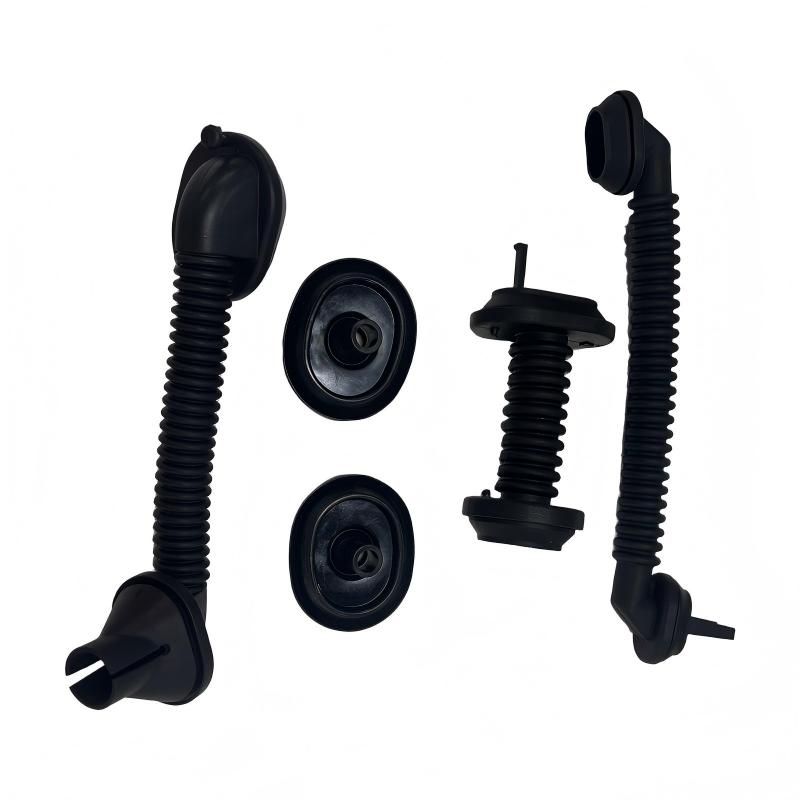
For molded automotive components such as EPDM automotive rubber bellows and door boot grommets, the mold must accommodate the corrugated structure, mounting geometry and required flexibility.
Once prototype samples are manufactured, they should be evaluated against the original technical requirements. This is one of the most important stages before customer approval.
Typical inspection and testing items for automotive rubber prototypes include:
Not every rubber component requires every test. The inspection plan should be determined by the part's function, customer specifications and applicable industry standards.
For example, a wiring harness grommet needs to provide reliable protection against abrasion and environmental ingress, while an engine sealing component may require additional evaluation of compression recovery and fluid compatibility.
Prototype inspection by the manufacturer does not automatically mean that the sample is approved for OEM production. The customer generally needs to review the sample and confirm whether it satisfies the project requirements.
During this stage, OEM engineers may conduct dimensional comparisons, installation trials and functional evaluations. If the sample does not meet expectations, feedback should be documented and communicated to the manufacturer.
Common reasons for sample revisions include:
After modifications, revised samples should be inspected again. Depending on the OEM's approval procedure, the final stage may include a signed sample, approved drawing, inspection report or other documented confirmation.
Clear communication during sample approval helps prevent misunderstandings between engineering, purchasing and manufacturing teams. It also establishes a consistent reference for subsequent production batches.
Once the sample is approved, the project moves toward production validation and mass manufacturing. However, approval of a prototype alone does not guarantee that every production batch will have identical performance.
The manufacturer must ensure that the approved material formulation, tooling configuration, molding parameters and inspection requirements are transferred into the production process.
Before regular production, OEM projects may require a pilot run or production trial to verify:
For automotive suppliers, quality management is particularly important because a small variation in a rubber component can affect assembly performance or long-term reliability. Fuste Rubber implements an IATF 16949 quality management system and provides customized rubber manufacturing services from formula development and mold fabrication to mass production.
Repeated prototype modifications can increase development costs and delay the launch of an automotive project. Although some adjustments are unavoidable, OEM buyers can improve development efficiency by preparing complete technical information and establishing clear approval criteria.
Incomplete drawings can lead to different interpretations of critical dimensions, tolerances and installation features. Providing updated 2D drawings and 3D CAD files helps the manufacturer understand the component structure before tooling begins.
Material changes during development may require adjustments to the compound, tooling and testing plan. OEM buyers should communicate temperature ranges, chemical exposure, hardness requirements and applicable performance standards as early as possible.
Before receiving prototypes, both parties should understand which dimensions and performance indicators are critical. A clear inspection checklist makes feedback more specific and reduces unnecessary sample revisions.
A supplier that understands both prototype development and mass production can identify manufacturing limitations earlier. This is particularly important for complex automotive rubber components that require customized tooling, specialized compounds or tight dimensional control.
When evaluating a supplier, OEM purchasing teams should review its material expertise, mold development experience, manufacturing equipment, quality management procedures and ability to support long-term production.
Selecting an automotive rubber parts manufacturer involves more than comparing sample prices or production quotations. The supplier should be able to support the technical and manufacturing requirements throughout the entire product development cycle.
For OEM and Tier 1 or Tier 2 projects, several capabilities deserve particular attention:
Fuste Rubber has specialized in molded rubber components and extruded rubber tubes since 2004. Its manufacturing operations cover a 20,000-square-meter production base, with more than 200 employees and an annual production capacity exceeding 5,000 tons, according to company information.
The company supplies customized rubber solutions for automotive electrical, engine, chassis, cooling and fuel systems. Its product range includes custom molded rubber components, rubber gasket seals and automotive hose products.
For projects involving automotive air intake systems, buyers can also review Fuste Rubber's automotive rubber grommet solutions and discuss customized component requirements with its technical team.
Successful automotive rubber part development requires close coordination between OEM engineers and the rubber manufacturer. Design review, material selection, prototype manufacturing, inspection and customer approval all contribute to the final production outcome.
The most important point is that prototype approval should establish a clear technical and quality reference for mass production. When the material, dimensions, performance requirements and manufacturing process are properly controlled, the transition from sample development to regular production becomes more predictable.
Fuste Rubber supports customized rubber component development for automotive and industrial applications, covering material formulation, mold design and manufacturing, sample verification and mass production.
If your automotive OEM project requires custom rubber grommets, bellows, seals, hoses or other molded rubber components, contact Fuste Rubber to discuss your drawings, samples and technical requirements.
Rubber part prototyping is the process of developing and evaluating preliminary rubber components before mass production. It allows OEM manufacturers to verify dimensions, material properties, fit and functional performance before approving production tooling and manufacturing.
A manufacturer typically needs 2D drawings or 3D CAD files, component dimensions, material requirements, hardness, operating temperature, application environment and expected production volume. Physical samples and testing specifications are also helpful when available.
EPDM, NBR, silicone, FKM and HNBR are commonly used in automotive rubber applications. EPDM is often selected for weather-resistant components, NBR for certain oil-resistant applications, silicone for high-temperature flexibility, and FKM for demanding heat and chemical environments.
Sample approval generally involves dimensional inspection, material and hardness verification, visual evaluation, functional testing and installation trials where applicable. The OEM customer reviews the results and confirms whether the sample meets the agreed specifications.
Yes. Custom rubber manufacturers can generally develop molded components and extruded products based on customer drawings, CAD files or physical samples, subject to design and manufacturing feasibility. Fuste Rubber provides customized rubber manufacturing solutions for automotive applications.
Prototype tooling is primarily used to produce initial samples for design and performance verification, often with a lower initial tooling investment. Production tooling is designed for repeatable manufacturing, production efficiency and the expected order volume. The appropriate approach depends on component complexity and project requirements.




 online service


